
Choosing between a treadmill and an exercise bike can be challenging, especially if you want to lose weight, burn calories, improve cardiovascular health, or build a home gym. Both machines offer effective indoor workouts, but they differ in calorie expenditure, joint impact, muscle engagement, and overall convenience.
So, is a treadmill or exercise bike better? The answer depends on your fitness goals, current fitness level, physical comfort, and the type of exercise you enjoy most.
In this guide, we’ll compare treadmill vs. exercise bike benefits, explore which machine burns more calories, examine their advantages for weight loss, and help you decide which is best for your home workout routine.
Treadmill vs. Exercise Bike: Quick Comparison
| Feature | Treadmill | Exercise Bike |
|---|---|---|
| Weight loss | Excellent for walking, jogging and running | Excellent for steady cycling and interval training |
| Calorie burning | Often higher during vigorous running | Can be comparable at similar workout intensities |
| Joint impact | Higher, particularly when running | Low-impact and generally gentler on joints |
| Muscles worked | Legs, glutes and stabilising muscles | Primarily quadriceps, hamstrings, calves and glutes |
| Cardiovascular fitness | Excellent | Excellent |
| Bone health | Provides weight-bearing exercise | Limited weight-bearing benefits |
| Beginner-friendly | Yes, particularly at walking speeds | Yes, especially with adjustable resistance |
| Home gym suitability | Usually needs more floor space | Often more compact |
| Best for | Walking, running and weight-bearing cardio | Low-impact cardio and controlled resistance training |
The verdict: A treadmill is a strong choice for walking, running, and weight-bearing exercise. An exercise bike is often the better option for low-impact cardio, particularly if joint comfort is a priority. Both can support weight loss and cardiovascular fitness.
1. Treadmill vs. Exercise Bike for Weight Loss
Weight loss is one of the most common reasons people invest in home cardio equipment. Both treadmills and exercise bikes can help you lose weight by increasing energy expenditure and supporting a consistent exercise routine.
However, neither machine guarantees weight loss on its own. Your overall calorie balance, eating habits, activity levels, and consistency all play important roles.
Is a treadmill better for weight loss?
A treadmill can be particularly effective for weight loss because it allows you to walk briskly, increase the incline, jog, or run. These options make it easy to adjust your workout as your fitness improves.

Treadmill workouts can help you:
- Increase calorie expenditure through walking or running.
- Add intensity with incline training and speed intervals.
- Build walking and running endurance.
- Incorporate weight-bearing movement into your routine.
Incline walking is especially useful if you want a challenging workout without running at high speeds. Start with a manageable incline and gradually increase the difficulty.
Is an exercise bike good for weight loss?
Yes. An exercise bike is an effective weight-loss tool because you can control resistance, cadence, and workout duration.
Stationary cycling can help you:
- Burn calories through moderate or vigorous exercise.
- Perform high-intensity interval training (HIIT).
- Exercise for longer periods with relatively little joint impact.
- Maintain a consistent routine regardless of weather conditions.
The seated position can also make cycling more comfortable for people who find running uncomfortable.

Which is better for losing belly fat?
Neither a treadmill nor an exercise bike specifically targets belly fat. Fat loss occurs throughout the body, and the areas where you lose fat first depend partly on individual biology.
Both machines can support overall fat loss when combined with a sustainable calorie deficit, balanced nutrition, adequate sleep, and regular physical activity.
Best choice for weight loss: Choose the machine that lets you exercise consistently at an appropriate intensity. A treadmill may be preferable if you enjoy brisk walking or running, while an exercise bike may suit you better if you prefer cycling or need a lower-impact workout.
2. Which Burns More Calories: Treadmill or Exercise Bike?
The question of treadmill vs. exercise bike calories does not have a universal answer. Calorie expenditure depends on your body weight, workout intensity, resistance, speed, incline, and session duration.
Running on a treadmill often burns more calories per minute than moderate cycling. However, vigorous cycling can match or exceed the energy expenditure of easier treadmill workouts.
For example, a brisk walk on a treadmill may burn fewer calories than a demanding stationary-bike session. Similarly, a hard treadmill run may burn more calories than leisurely cycling.
The most important factors are:
- Intensity: Higher-effort workouts generally use more energy.
- Duration: Longer sessions can increase total calorie expenditure.
- Body weight: Larger bodies typically use more energy performing the same activity.
- Fitness level: Your body’s energy expenditure varies with the task and your efficiency.
- Consistency: Regular workouts contribute more to long-term results than occasional intense sessions.
Fitness-machine calorie counters are estimates rather than precise measurements, so avoid treating their readings as exact.
Winner for calorie burning: The treadmill often has an advantage during vigorous running, but the exercise bike can be equally effective in some circumstances. Compare workouts at similar effort levels rather than assuming one machine always burns more calories.
3. Treadmill vs. Exercise Bike for Joint Health
Joint comfort is one of the biggest differences between these two machines.
Treadmill: A weight-bearing workout
Walking and running on a treadmill require your body to support its weight with each step. Walking is generally lower impact than running, while running creates greater repetitive loading.
Treadmill exercise may be suitable if you want to improve walking endurance, maintain an active lifestyle, or include weight-bearing activity in your fitness routine.
However, running may aggravate symptoms for some people with knee, hip, ankle, or foot problems.
Exercise bike: Low-impact cardio
An exercise bike supports your body in a seated position and eliminates the repeated foot strikes associated with walking and running.
Potential benefits include:
- Less impact on the lower-body joints.
- Adjustable resistance for gradual progression.
- A stable exercise position.
- Options for people who find weight-bearing exercise uncomfortable.
A recumbent exercise bike, which has a supported seat and backrest, may be particularly comfortable for some users.
Nevertheless, cycling is not completely free from joint strain. Excessive resistance, poor seat positioning, or an unsuitable riding position can cause discomfort.
If you have persistent joint pain or are recovering from an injury, seek advice from a qualified healthcare professional before choosing or progressing your workout.
Winner for low-impact exercise: The exercise bike generally has the advantage, especially for people who find running or prolonged walking uncomfortable.
4. Which Machine Works More Muscles?
Both machines primarily exercise the lower body, but their movement patterns differ.
Muscles worked on a treadmill
Treadmill walking and running engage:
- Quadriceps.
- Hamstrings.
- Gluteal muscles.
- Calf muscles.
- Core and other stabilising muscles.
Incline walking can increase the demand on the glutes and calves. Running also requires greater dynamic control and coordination than easy walking.

Muscles worked on an exercise bike
Stationary cycling mainly engages:
- Quadriceps.
- Hamstrings.
- Gluteal muscles.
- Calf muscles.
Increasing the resistance can make the workout more demanding for your leg muscles. However, cardio exercise alone is generally less effective for substantial muscle growth than a well-designed progressive resistance-training programme.
Upright and recumbent bikes differ in body position, but neither should be considered a complete full-body strength workout.
Winner for overall movement: The treadmill involves weight-bearing movement and more whole-body stabilisation. The exercise bike is particularly effective for focused lower-body cardiovascular exercise.
If building strength or muscle is your main goal, consider combining either machine with resistance training.

5. Treadmill vs. Exercise Bike for Cardiovascular Health
Both treadmills and exercise bikes can improve cardiovascular fitness when used regularly at an appropriate intensity.
Cardio exercise helps train your heart and lungs, improves aerobic endurance, and can contribute to healthier blood pressure and metabolic health.
Benefits of treadmill cardio
A treadmill is useful for:
- Improving walking and running endurance.
- Training for running events.
- Practising different speeds and inclines.
- Building aerobic fitness through continuous or interval workouts.
Benefits of exercise-bike cardio
An exercise bike is useful for:
- Developing cycling endurance.
- Performing controlled resistance-based workouts.
- Alternating between easy and vigorous intervals.
- Maintaining cardiovascular activity with relatively little impact.
Neither machine is inherently superior for heart health. Your results depend on workout frequency, duration, intensity, and your ability to sustain the routine.
For general health, NHS physical activity guidance recommends that adults aim for at least 150 minutes of moderate-intensity activity or 75 minutes of vigorous-intensity activity each week, alongside muscle-strengthening activities on at least two days.
Choose an intensity that matches your fitness level, and build up gradually if you’re starting from a sedentary lifestyle.
6. Treadmill vs. Exercise Bike for Beginners
If you’re new to exercise, the best machine is one that feels manageable, comfortable, and easy to use consistently.
Why beginners may prefer a treadmill
A treadmill makes it easy to begin with ordinary walking. You can start slowly, gradually increase your pace, and introduce an incline when you’re ready.

Walking is familiar and requires relatively little technical learning. However, running too soon or increasing training volume too quickly can lead to discomfort or injury.
Why beginners may prefer an exercise bike
An exercise bike offers controlled resistance and a stable seated position. You can start with light resistance and increase the difficulty as your endurance improves.
It can be a useful option if you’re concerned about balance or prefer to avoid repetitive impact.

Correct setup matters: adjust the seat so your knee retains a slight bend when the pedal is at its lowest position.
Best for beginners: Both are suitable. Choose a treadmill if you enjoy walking, or an exercise bike if you prefer seated, low-impact exercise.
7. Which Is Better for Home Workouts?
If you’re deciding which cardio machine to buy for your home gym, consider more than exercise benefits.
Space requirements
Treadmills generally require more floor space and clearance for safe use. Some fold for storage, although folding does not eliminate the need for adequate operating space.
Exercise bikes are often more compact, making them a practical choice for smaller rooms or flats.
Noise levels
Exercise bikes are often quieter than treadmills because they lack the repeated foot strikes and, on motorised models, the motor noise associated with treadmill use.
Actual noise depends on the model, construction, maintenance, flooring, and workout intensity.
Cost and maintenance
Prices vary substantially by brand, build quality, features, and market.
Treadmills may require attention to the running belt, deck, motor, and lubrication requirements. Exercise bikes generally have fewer large moving components, although their pedals, resistance mechanisms, flywheels, and electronics still require maintenance.
Before purchasing, compare the warranty, maximum user weight, available workout programmes, storage options, and expected maintenance costs.
Best for smaller home gyms: An exercise bike will often be the more space-efficient choice. A treadmill may be worth the extra room if walking or running is central to your fitness goals.
8. Pros and Cons of a Treadmill vs. Exercise Bike
Treadmill pros

- Supports walking, jogging, and running.
- Allows adjustable speed and incline.
- Provides weight-bearing exercise.
- Useful for running-specific fitness goals.
- Can accommodate both gentle and demanding workouts.
Treadmill cons
- Running creates repetitive impact.
- Often requires more floor space.
- Can be noisier than a stationary bike.
- May be uncomfortable for people with certain joint problems.
Exercise bike pros
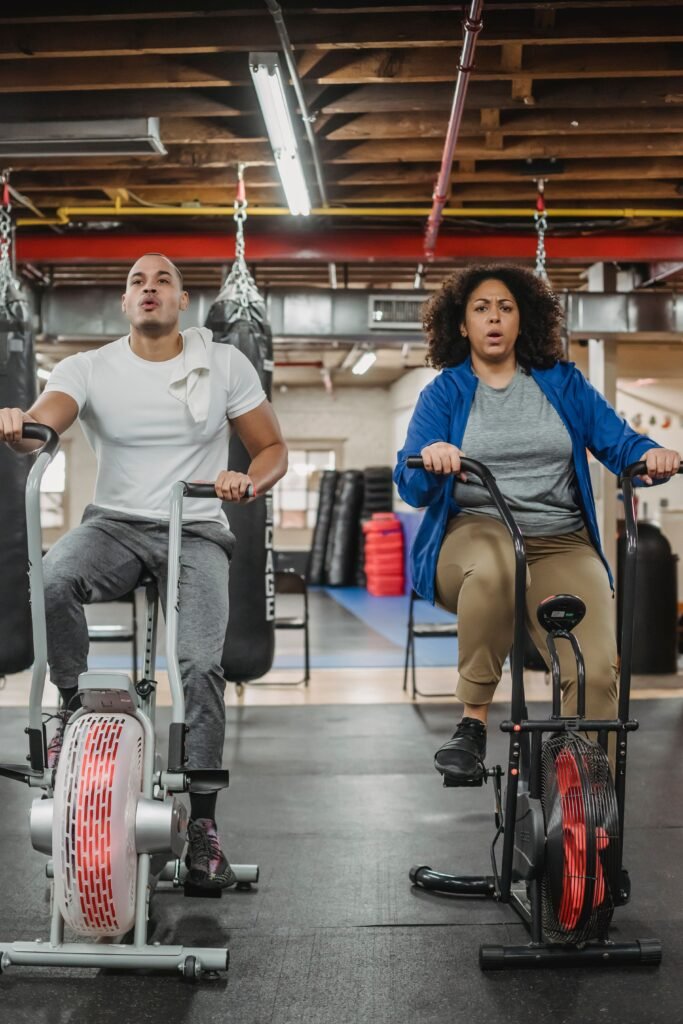
- Offers low-impact cardiovascular exercise.
- Allows precise resistance adjustment.
- Often takes up less space.
- Supports steady-state cardio and interval training.
- Can be a comfortable option for many beginners.
Exercise bike cons
- Provides less weight-bearing stimulus for bone health.
- Primarily targets the lower body.
- Incorrect setup or excessive resistance can cause discomfort.
- May be less appealing to people who prefer walking or running.
9. Can You Use Both a Treadmill and an Exercise Bike?
Absolutely. Using both machines can add variety to your training and help you balance different types of cardiovascular exercise.
For example, you could use the treadmill for walking and incline sessions, then use the exercise bike for lower-impact recovery days or interval workouts.
A simple weekly routine might look like this:
| Day | Workout |
|---|---|
| Monday | 25–30 minutes of brisk treadmill walking |
| Tuesday | 20–30 minutes of moderate cycling |
| Wednesday | Strength training or gentle activity |
| Thursday | 25 minutes of treadmill walking with optional incline |
| Friday | 20–30 minutes of stationary cycling |
| Saturday | Enjoyable outdoor activity or an easy cardio session |
| Sunday | Rest or gentle movement |
Adjust the duration and intensity to your current fitness level. You do not need to perform every session at high intensity, and beginners can start with shorter workouts.
Combining both machines is not essential, however. If you only have room or budget for one, a single machine can provide an effective long-term cardio routine.
10. Treadmill or Exercise Bike: Which Should You Choose?
Your fitness goals should guide your decision.
| Your goal | Recommended option |
|---|---|
| Lose weight | Either machine |
| Burn calories through running | Treadmill |
| Low-impact cardio | Exercise bike |
| Improve running performance | Treadmill |
| Exercise with sensitive joints | Often an exercise bike, depending on your condition |
| Support bone health with weight-bearing exercise | Treadmill walking, if appropriate |
| Train lower-body endurance | Exercise bike |
| Exercise in a small home gym | Often an exercise bike |
| Start with simple walking workouts | Treadmill |
| Improve cardiovascular fitness | Either machine |
Remember that these recommendations are general. Your medical history, mobility, symptoms, and personal preferences may change which option is most suitable.
Frequently Asked Questions
Is a treadmill better than an exercise bike?
A treadmill may be better for running, incline walking, and weight-bearing exercise. An exercise bike may be better for low-impact cardio and people who prefer a seated workout. Neither is universally superior.
Which is better for weight loss: a treadmill or exercise bike?
Both can support weight loss by increasing calorie expenditure. The best option is the one you can use consistently at a suitable intensity while maintaining sustainable nutrition habits.
Does a treadmill burn more calories than an exercise bike?
Running on a treadmill often burns more calories than moderate cycling, but results depend on intensity, duration, body weight, and other factors. Vigorous cycling can also produce substantial calorie expenditure.
Is an exercise bike better for bad knees?
An exercise bike is often a lower-impact alternative to running and may be more comfortable for some people with knee problems. However, the correct seat position and resistance are important, and some knee conditions require individual guidance.
Can I lose belly fat using an exercise bike?
Yes, stationary cycling can contribute to overall fat loss when combined with appropriate nutrition and regular activity. However, it does not specifically target belly fat.
Is 30 minutes on a treadmill better than 30 minutes on an exercise bike?
Not necessarily. Thirty minutes of vigorous cycling may be more demanding than 30 minutes of easy treadmill walking. Compare the intensity of each session rather than the duration alone.
Which is better for seniors: a treadmill or an exercise bike?
The best option depends on mobility, balance, joint comfort, and health status. A stationary or recumbent bike may be suitable for someone who prefers seated exercise, while treadmill walking may be appropriate for someone who can walk safely and wants weight-bearing activity.
Can an exercise bike replace walking?
An exercise bike can provide excellent aerobic exercise, but it does not fully replicate walking’s weight-bearing benefits or its role in practising everyday walking. A combination of cycling, walking, and strength training may provide a more balanced programme.
Final Verdict: Treadmill vs. Exercise Bike
When comparing a treadmill vs. exercise bike, the best choice depends on your priorities.
Choose a treadmill if you enjoy walking or running, want to train for running events, or want to include weight-bearing cardio in your routine.
Choose an exercise bike if you prefer low-impact exercise, want adjustable resistance, or need a compact option for home workouts.
If your main goal is weight loss or cardiovascular health, either machine can be effective. Regular exercise, gradual progression, and a routine you enjoy are more important than choosing the machine that appears to have the biggest advantage on paper.
Ultimately, the best cardio machine is the one that fits your body, your lifestyle, and your long-term fitness goals.